

In the world of commercial real estate development, success is often judged by what is visible: the sleek glass curtain walls, the marble-clad lobbies, and the soaring heights of the skyline. However, for the people who own, manage, and inhabit these buildings, true success is defined by what is invisible.
Imagine a premium office tower where the elevators are sluggish, the air is stagnant by 2:00 PM, and the water pressure fails on the top floors. No matter how beautiful the architecture, that building is a failure. This is why MEP Engineering—Mechanical, Electrical, and Plumbing—is not just a technical checklist; it is the strategic backbone of every high-performing commercial asset.
At Genisys Engineers, we specialize in designing the “internal organs” of a building to ensure that your investment is efficient, safe, and profoundly profitable.
Part 1: What Is MEP Engineering? (The Foundation)
To understand why MEP is the backbone of success, we must first look at the three vital systems it comprises. While these disciplines are distinct, they must function as a single, synchronized unit.
1. Mechanical Engineering (The Lungs)
In a commercial context, mechanical engineering focuses primarily on HVAC (Heating, Ventilation, and Air Conditioning). These systems do more than just change the temperature; they manage air filtration, humidity control, and CO2 levels.
- Key Components: Chillers, Air Handling Units (AHU), Variable Refrigerant Flow (VRF) systems, and specialized smoke extraction for fire safety.
2. Electrical Engineering (The Heart)
The electrical system provides the energy that brings a building to life. In modern commercial projects, this goes far beyond simple wiring. It includes complex power distribution (HT/LT), backup power systems, and “smart” infrastructure.
- Key Components: Transformers, Switchgear, Uninterrupted Power Supply (UPS) for data centers, LED lighting automation, and lightning protection.
3. Plumbing Engineering (The Arteries)
Plumbing in a commercial high-rise is a feat of fluid dynamics. It involves the movement of water and waste across vast vertical and horizontal distances while maintaining precise pressure.
- Key Components: Domestic water boosters, wastewater treatment, greywater recycling, and critical fire suppression systems like sprinklers and hydrants.
Part 2: The Backbone of Every Successful Commercial Project
Now that we understand the “What,” let’s explore the “Why.” Why is MEP considered the most critical factor in a project’s long-term success? In 2026, as building codes tighten and tenant expectations rise, the “MEP Backbone” provides five essential pillars of value.
1. Financial Vitality: Lowering Lifecycle Costs
The initial cost of construction is only the tip of the iceberg. Over the 30-to-50-year lifespan of a commercial building, operational expenses (OPEX) will eventually dwarf the original capital expenditure (CAPEX).
- The MEP Impact: An optimized MEP design focuses on energy efficiency. By utilizing AI-driven HVAC controls and high-efficiency electrical distribution, Genisys Engineers can help developers reduce monthly utility bills by 20% to 30%. This directly boosts the building’s Net Operating Income (NOI) and overall market valuation.
2. The Power of BIM: Eliminating On-Site "Clashes"
In the past, construction delays were often caused by “field conflicts”—for example, a large AC duct trying to occupy the same space as a plumbing main. Resolving these on-site is slow, messy, and incredibly expensive.
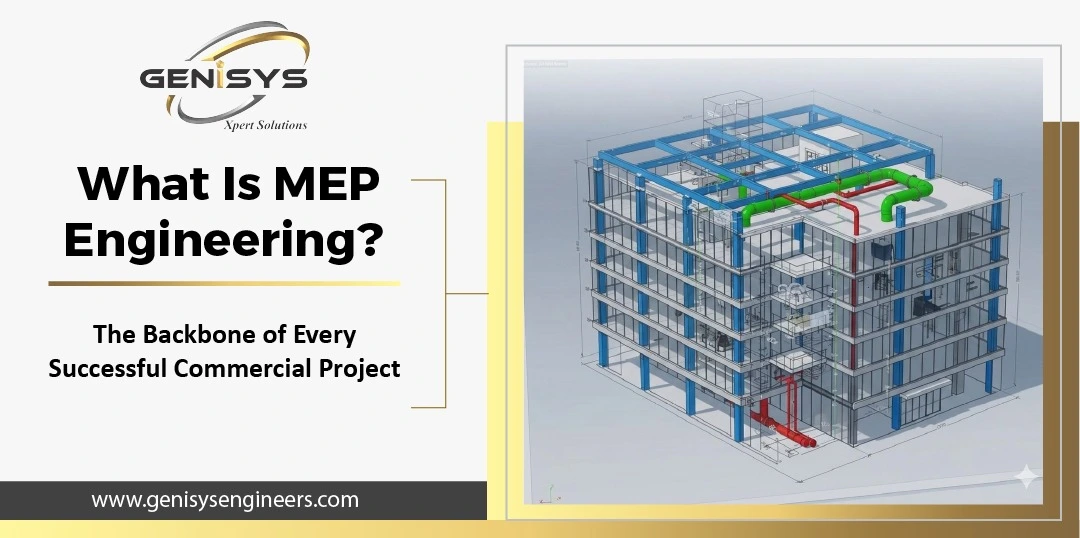
- The Backbone Strategy: We use Building Information Modeling (BIM) to create a 3D digital twin of the building before a single shovel hits the dirt. This allows us to perform “Clash Detection,” ensuring that every pipe, wire, and duct is perfectly coordinated. For a developer, this means fewer change orders, zero wasted material, and a project that stays on schedule.
3. Occupant Productivity and Retention
A commercial building’s “customers” are its tenants. In the age of hybrid work, the physical office must offer an environment that is superior to the home.
- The Human Element: Studies show that poor air quality and lighting can decrease worker productivity by up to 15%. MEP engineering ensures optimal Indoor Environmental Quality (IEQ). When the air is fresh and the lighting mimics natural circadian rhythms, tenants are happier, more productive, and—most importantly—more likely to renew their leases.
4. Safety, Compliance, and Risk Mitigation
Commercial projects are subject to rigorous safety standards (such as NBC, NFPA, or local municipal codes). A failure in the MEP “backbone” isn’t just an inconvenience; it’s a liability.
- Engineering for Safety: From fire alarm systems that detect smoke in seconds to emergency power that keeps stairwells lit during an outage, MEP is your first line of defense. Professional engineering ensures your project is fully compliant, reducing insurance premiums and protecting the lives of every occupant.
5. Future-Proofing: Building for 2030 and Beyond
Technology is moving faster than concrete can dry. A successful commercial project today must be ready for the “Smart Building” revolution.
Scalable Infrastructure: We design MEP systems with scalability in mind. Whether it’s adding Electric Vehicle (EV) charging stations in the parking garage or integrating IoT sensors for “touchless” building entry, a strong MEP backbone allows your building to evolve without requiring a total overhaul.
The Genisys Difference: More Than Just Blueprints
At Genisys Engineers, we believe that engineering is a collaborative art. We work as a bridge between the architect’s aesthetic vision and the contractor’s practical reality. Our goal is to ensure that the “backbone” we design is so robust and efficient that the building owners never have to think about it.
Our comprehensive service suite includes:
- Pre-Design Consulting: Feasibility studies to ensure your goals match your budget.
- Integrated MEP Design: Synchronized Mechanical, Electrical, and Plumbing plans.
- Sustainability & LEED Support: Helping you achieve green building certifications.
- Construction Oversight: Ensuring that what was designed on paper is exactly what is built on-site.
Conclusion:
When planning your next commercial venture, remember: architecture may sell the building, but MEP engineering runs the building. By investing in high-quality MEP design from the start, you are protecting your budget from rework, your tenants from discomfort, and your future self from skyrocketing energy costs.
In the competitive landscape of 2026, a strong, efficient “backbone” is the ultimate competitive advantage.